


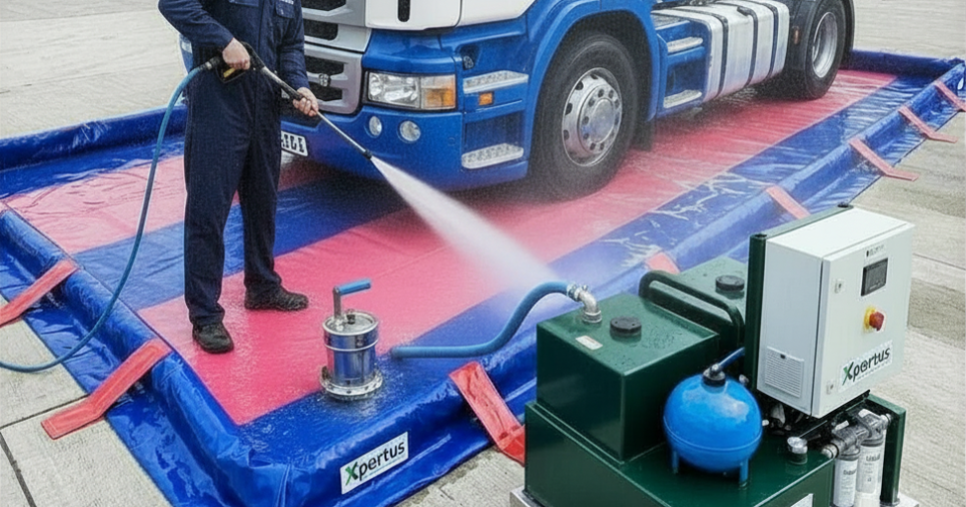
Why choose a mobile closed–circuit car wash?
Video: LOUP MF® forestry machinery washing at its best
Context of temporary and leased sites
On a construction site, in a temporary workshop or at a leased site, the washing of machinery (construction, agricultural and forestry), commercial vehicles or parts is an operational necessity, whilst investment in permanent infrastructure is often incompatible with the constraints of duration, footprint and site restoration.
The requirement is therefore typically for a solution that is deployable, reversible and justifiable: to set up a washing area quickly, collect the effluent, treat it and recycle the water where appropriate.
In this context, a mobile washing station with water recycling aims to achieve two objectives:
- To control the risk of pollution (soil, stormwater systems, the natural environment)
- And to reduce water abstraction by maintaining a reuse loop.
- These objectives are directly in line with the spirit of the Water Framework Directive 2000/60/EC and its transposition into French law, which provide the framework for the protection of water resources and aquatic environments.
Legal risks and evidential issues
- Beyond environmental common sense, a washing system must prevent any uncontrolled discharge: the Environment Code (Article L216–6) imposes criminal penalties for discharges or spills likely to cause harmful effects on water bodies and the environment.
- In practice, during an inspection, compliance depends as much on technical robustness as on the ability to provide documentation: design, maintenance, sludge and hydrocarbon disposal systems, and, where applicable, analyses.
- At certain sites, the activity may also fall under a specific regime for classified installations.
- For example, workshops specialising in the repair and maintenance of motor vehicles and machinery may be subject to category 2930 and its requirements, notably under the Order of 12 May 2020 (category 2930, registration scheme).
The key point is to incorporate these requirements right from the design stage (effluent management, pollution prevention, operation).
Typical pollutants in wash water

Composition and impacts on treatment
Water used to wash machinery and vehicles most commonly contains:
– SS (suspended solids): soil, fine mineral particles, construction sludge, dust;
– hydrocarbons: oils, greases, fuels, hydraulic fluids;
– surfactants/detergents: stabilisation of emulsions, reduced efficiency of unsuitable separators;
– depending on the circumstances: soot, fine particles, trace metals (maintenance, workshop).
These pollutants have a direct impact on the treatment design: suspended solids determine the risk of clogging, hydrocarbons determine the need for separation, and surfactants determine sensitivity to emulsions (and therefore the choice of stages and the operating strategy).

Common errors at temporary sites
The most frequently observed non–compliances at temporary sites are:
- Washing on bare ground, washing on tarmac without collection, or discharge into a storm drain.
- These practices expose sites to the risk of contamination via runoff and infiltration, and result in costly corrective measures (emergency pumping, disposal via an authorised channel, temporary suspension of operations).
- A well-designed mobile solution must therefore prioritise containment and collection even before treatment
Design criteria: the barrier approach
- System logic: contain, treat, utilise
- An effective treatment plant relies on a series of barriers: containment (sealing), collection (hydraulics), pre-treatment (solids), separation (hydrocarbons), polishing (filtration), stabilisation (sanitary control), followed by recycling or controlled discharge.
- At OCEANIA Environment (XPERTUS range), this approach is prioritised to ensure a system that can be operated by field teams and justified during inspections.
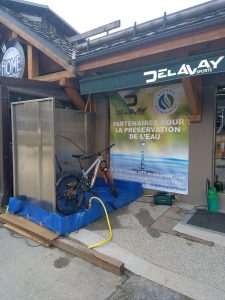
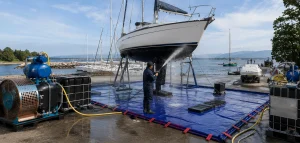
Washing area: containment and ergonomics
Waterproofing and water collection
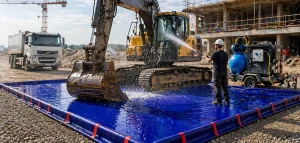
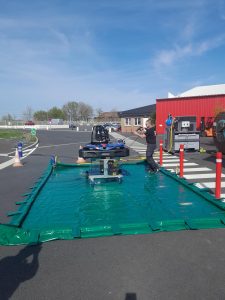
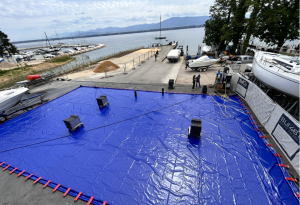
- The primary requirement is a waterproof, flexible containment area or liner: no water must escape from the washing area, even under adverse conditions (rain, mud, traffic).
- On a site without civil engineering works, a flexible area with raised perimeter brackets can meet this requirement provided it is suitable for vehicle traffic, the gradient and puncture resistance, and incorporates a low-point collection point. (lift pump with screen, drain valve for complete emptying, and a kit of reinforced rubber strips for wheel passage)
Vehicle compatibility and safety of use
- An effective washing area is one that operators actually use.
- Key points to check are: usable dimensions, ramps, access, grip, vehicle guidance, and minimising splashing.
- On sensitive sites, splash guards can be useful for controlling nuisance whilst maintaining a smooth flow of traffic.
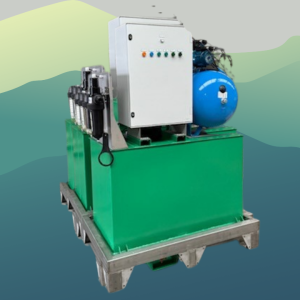
Hydraulics: collection, pumping, buffer tanks
- Instantaneous flow rate and treated flow rate
- The design must distinguish between the flow rate during washing (high-pressure gun, cycles) and the treatment flow rate (stable nominal flow).
- A robust system usually incorporates a buffer tank to absorb peaks (end of shift, muddy return flow after rain) and avoid bypasses.
Pumping and coarse pre-filtration
- The choice of pump depends on particle size, abrasion (sand) and the risk of sludge entrainment.
- The key criteria are: accessibility for cleaning, protection against dry running, and verifiability.
- Upstream coarse pre-filtration (basket, screen) protects the fine filtration stages and reduces downtime.
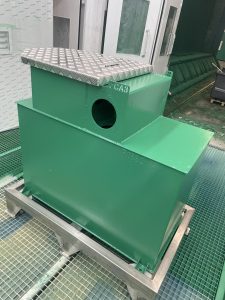
SS Management: Settling and Sludge
Why SS drive reliability
- In mobile treatment plants, SS are the number one cause of underperformance: clogging, increased maintenance, and reduced hydrocarbon separation.
- Pre–treatment must therefore be regarded as a production unit (rather than an accessory).
Extraction and management process
- The design criteria are: sufficient retention time in the settling tank, low points, inspection hatches, simple drainage, and a logistics strategy (temporary storage, disposal).
- An example of pre-treatment equipment is our hydrocarbon separator, used to organise a viable settling process on site depending on the effluent and the usage scenario.
Hydrocarbons: compliant separation and monitoring
- Technical reference: EN 858
- For effluents containing oils and fuels, separation is typically based on the requirements of the EN 858 series (design, performance and operation of light liquid separators).
- The standard is available via the national standards body: NF EN 858-1.
Anti–bypass and consistent process flow
Effective separation must remain stable despite variations in temperature, suspended solids load and the possible presence of surfactants.
The critical points are:
- avoiding configurations that encourage bypassing under overload conditions, ensuring accessibility for monitoring and draining, and positioning the separator in a process stream where suspended solids have already been reduced to limit fouling.
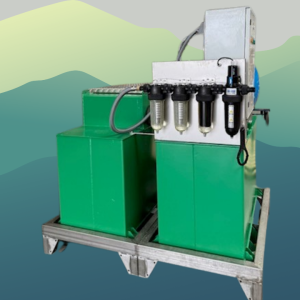
- A typical mobile solution is the skid-mounted hydrocarbon separator, which is suitable when the aim is to have a deployable separation stage with appropriate maintenance logistics.
Polishing filtration: stabilising the recycle
Why does the loop degrade the water if it is not stabilised? Recycling requires stable quality.
- Water that is acceptable for a single wash may become unsuitable for reuse in a recirculating loop due to the accumulation of fines, odours and the development of biofilm.
- Multi-stage filtration serves to limit residual fines, protect the final stages and maintain an effective flow rate, with clogging indicators and a clear strategy for consumables.

Examples of mobile systems
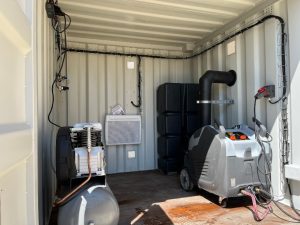
- Depending on the constraints (flexible base, skid, container), solutions incorporating collection, separation, filtration and recycling may be considered, for example:
- A mobile washing unit with water recycling, such as the ATLANTIK® V1–COMPACT or XP–ATLANTIK®CONT. The choice is based on operational criteria (throughput, variability, ease of dismantling, available energy) rather than on a catalogue flow rate.
Sanitary control: UV and operation
The role of disinfection in recycled water
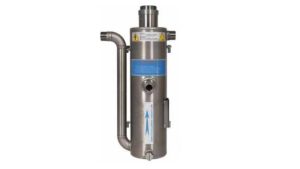
- In a recycling loop, controlling the growth of microorganisms (odours, secondary turbidity, biofilm) is essential for continuous operation, particularly if the system remains in place for several weeks.
- UV disinfection must be sized according to transmittance, and therefore according to the efficiency of the upstream filtration.
Equipment and operating conditions
- A UV lamp-reactor system is typically installed downstream of the polishing stages.
- A winterisation procedure, restart instructions and simple checkpoints must be provided for multi-skilled operators.
Control: recycling, discharge, safety shutdown
Defining clear operating modes : A mobile station must offer explicit operating modes:
- recycling (closed circuit, minimising top-up),
- controlled discharge where authorised (to a designated point, with the option of taking samples),
- and safety shutdown (shutdown, containment) in the event of a fault.
- The control system must incorporate level alarms, blockage indicators and access to sampling points.
Point to note: connection to the sewerage system
- If discharge into the sewerage network is envisaged, this must comply with the locally applicable authorisations and requirements (sewerage authority, connection conditions, required specifications).
- As regards the general framework for sewerage systems, the Order of 21 July 2015 on collective sewerage systems serves as a key reference, although the specific conditions for industrial discharge are subsequently governed by local regulations and associated agreements/orders.
Deployment: transport and reversibility : Logistics and commissioning
- On leased premises, value is measured by the time taken to commission the system, transport compatibility (skid, forklift, pallet truck), and full reversibility at the end of the lease.
- A pre-assembled design, standardised connections and concise operating documentation are key drivers of success.
Capacity sizing: the 3 key decisions
To properly define the scope of a project, the following must be established from the outset:
(1) the main objective (recycling vs. discharge),
(2) the solids load (adverse weather conditions, sludge),
(3) the operational strategy (maintenance frequency, sludge disposal, consumables).
Without this, poor performance is almost always caused by upstream factors (site, catchment, suspended solids) rather than the ‘core’ treatment process.
An opening statement on evolving requirements
Towards greater modularity and traceability
In the medium term, expectations are moving towards mobile solutions that are more modular, more water-efficient and easier to audit (maintenance monitoring, key parameters, sampling points), in order to adapt to site constraints and regulatory checks.
Conclusion: on-site criteria and benefits : What makes a treatment plant compliant with regulatory requirements
A mobile washing plant with water recycling, for construction sites, temporary workshops and rented premises, must be designed as a complete system: watertight retention, reliable collection, suspended solids management, hydrocarbon separation (in accordance with EN 858), polishing filtration, hygiene control and simple operation.
The benefits are tangible:
reduced risk of pollution, business continuity under varying conditions, and control over water top-ups.
CTA: Select the right size for your needs
To select a solution tailored to your site (flow rate, type of pollutants, space constraints, recycling or discharge scenario), you can contact XPERTUS® for a technical assessment and a quotation, with a configuration based on your actual operating conditions.
Contact us
Ask us for a technical assessment and a quotation, with a configuration based on your actual operating conditions.