


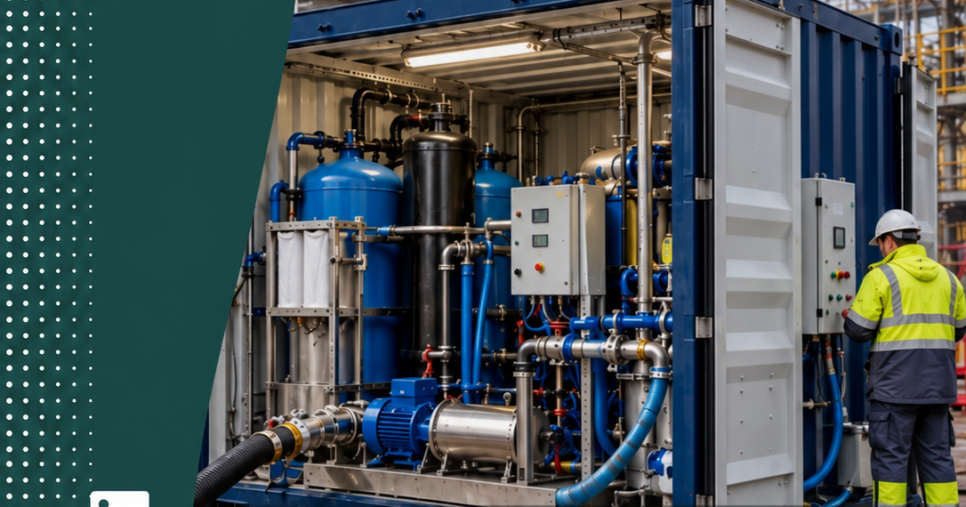
Mobile hull-maintenance wastewater treatment unit for your slipway
X’Pertus® designs mobile hull-maintenance wastewater treatment units in 10- or 20-foot containers, sized to the actual effluent generated at your slipway and to the flow rate of your pressure-washer lances.
If you service vessels from 20 to 150 metres on a rented slipway and the prospect of pouring concrete gives you pause, we reviewed the 2026 regulatory risks and requirements in our article on hull-maintenance wastewater in shipyards.
Now for the solution: collect, treat and recycle water without major civil works.
KEY POINTS
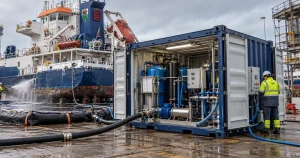
Our solution: a ready-to-install washing and hull-maintenance unit in a 10-foot container, with collection, pumping, filtration, an oil-water separator, storage and optional water recycling. It is installed beside the slipway, requires no civil works, and can move with you.
- A hull-maintenance wastewater treatment unit is sized from the analysis of a five-litre sample and the instantaneous flow rate of the pressure washers — never from a standard template.
- Wash water passes through up to five treatment stages: solids are removed first, followed by hydrocarbons, fine particles and dissolved pollutants; disinfection is added when the water is recycled.
Documented management of hull-maintenance wastewater is becoming a competitive advantage in maritime tenders. Clients are requesting it increasingly often.
Which hull-maintenance wastewater treatment system should be selected for vessels from 20 to 150 m?
- The correct treatment system is a sequence of treatment stages selected from the analysis of your actual effluent and capable of handling the combined flow of two or three pressure washers operating simultaneously.
- A yard that handles a 30-metre vessel occasionally is fundamentally different from a slipway processing 100-metre vessels back-to-back. The effluent belongs to the same broad family, but the flow rates are not the same, so the installation cannot be the same either.
- Depending on the analytical results, the unit incorporates all or part of the following treatment modules: belt filter, oil-water separator, fine filtration, activated-carbon canisters of 30, 60 or 100 litres, followed by ozone or UV treatment.
| TREATMENT STAGE | WHAT IT REMOVES | WHEN IT IS USED | KEY OPERATING POINT |
| Collection and pumping | All wash water around the vessel | Always — this is the basis of the system | Pump flow rate sized to the lances, not to the daily average |
| Belt filter | Suspended solids, shell debris, sand, flakes | High solids loading; heavily fouled hulls | Dispose of captured solids through an appropriate waste route |
| Oil-water separator | Free hydrocarbons and grease | Mechanical work, bilge water, leaks | Planned emptying and easy operator access |
| 20 µm then 5 µm filtration | Fine particles and antifouling-paint pigments | Upstream of activated carbon, to protect it | Pressure gauge to anticipate filter clogging |
| Activated carbon | Biocides, dissolved metals and detergents | When antifouling compounds are present and copper/zinc discharge limits must be met | Canister capacity sized to the measured contaminant load |
| Ozone or UV | Oxidisable compounds and microbiological risk | Water recycling and operator protection | Closed reactor, ventilation and control of residual ozone |
How should a hull-maintenance area be sized?
Sizing a hull-maintenance area starts with a sample of approximately five litres of wash water, analysed by a laboratory, together with the combined flow rate of the pressure washers that operate at the same time.
X’Pertus®, your effluent-management equipment supplier, manages the analysis. The results determine which contaminants must be retained, separated and filtered, and the flow rate the unit must handle and return if water recycling is included.
- The applicable discharge limits are set by the site-specific Prefectural Order, with the French Order of 2 February 1998 on discharges from classified installations used as a regulatory reference.
- The classic pitfall is an installation that can “treat” an impressive daily volume but cannot absorb the flow from three pressure-washer lances running for twenty minutes. The water queues up, the painters queue up, and the slipway remains blocked. Holding up the water means holding up the vessel. The unit must treat continuously, at the same rate as the lances.
How should wash water be collected around the vessel?
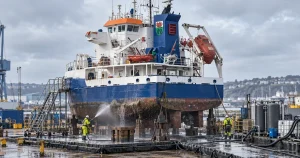
A flexible containment area beneath the work zone, or containment booms installed on the existing slipway, channels the water towards the pumping point without any excavation or groundworks.
This is the point that is most often overlooked, yet it is the first one to address. Even the best hull-maintenance wastewater treatment unit is useless if one third of the water reaches the harbour basin before it is pumped.
In practical terms:
- Containment booms and flexible containment areas can define the work zone within a few hours.
- Flexible containment remains continuous where boards or rigid kerbs would allow water to pass through.
- The containment layout is designed around the movement of plant, mobile platforms and handling equipment, which can continue to circulate.
Why use a mobile containerized unit rather than a fixed installation?
- A 10- or 20-foot containerized hull-maintenance wastewater treatment unit follows your operations: a new slipway, a new contract or a relocation — the unit moves with you.
- Many operators work on a slipway or technical area they do not own. Financing a fixed installation that remains with the port operator means paying for an asset that ultimately belongs to someone else.
- With a skid-mounted or containerized unit, you invest in your own production asset. If you secure a contract at another slipway, the unit can be loaded onto a truck.
- If the nature of the activity changes, the treatment train can be reconfigured module by module rather than replaced from scratch. The most compact configuration is described in our 10-foot container washing and hull-maintenance data sheet.
Bilge water: how can disposal volumes be reduced?
- A skid-mounted oil-water separator installed upstream separates the oil phase from the water and reduces the volume that must be sent to a hazardous-waste treatment route.
- Bilge water presents a different issue from hull wash water: large volumes of water containing relatively small quantities of oil, grease and hydrocarbons. Sending the entire volume to a specialist contractor means paying to transport and treat water that did not require that level of treatment.
- The calculation is site-specific and depends on composition, volumes, disposal-route costs and site requirements. However, on a busy slipway processing vessels continuously, the cost difference becomes apparent very quickly. The product range is presented on our hydrocarbon- and grease-effluent treatment page.
What commercial benefit can you gain from treated hull-maintenance wastewater?
- A shipyard that can explain to a shipowner where every litre of wash water goes, how it is treated and what proportion is recycled turns a regulatory constraint into a sales argument.
- In the maritime sector, as in construction and rail, specifications increasingly include discharge control, wash-water recovery and traceability. When these requirements become mandatory, hull-maintenance wastewater treatment stops being an added benefit: it becomes a prerequisite for bidding.
- The cost of the installation is therefore no longer compared only with the risk of a penalty. It must also be compared with the value of the contracts it enables you to win — or prevents you from losing.
EXPERT ADVICE
Advice from François Rivalland, founder of X’Pertus®
“When we design a unit, I always ask the same question: who is going to change the filters, at what height, and what will they be holding? If the answer is ‘someone leaning over a sludge tank while wearing a mask’, then we have designed something incorrectly. The process should operate in a closed loop, connections should be made without contact with the water, and the ozone generator should be enclosed and ventilated. PPE comes afterwards, based on the safety data sheets for the substances actually identified in the sample. Our principle can be summed up in one line: treat the effluent without creating a new constraint for the operator.”
Frequently asked questions about mobile hull-maintenance wastewater treatment
Are civil works required to install a mobile hull-maintenance wastewater treatment unit?
No excavation and no building permit are required for the containerized unit and flexible containment system. A load-bearing surface is required for the container, together with an electrical supply and a pumping point. The containment system is laid on the existing slipway and can be moved if the site configuration changes.
Can treated hull-maintenance wastewater be recycled for subsequent washing?
Yes. When the treatment train includes activated carbon and UV or ozone disinfection, with outlet quality monitoring, the treated water can be recycled. This reduces mains-water consumption and allows washing to continue during water-use restrictions. The recycling system is sized so that the water remains safe for the operator who sprays it.
How many pressure washers can the unit handle at the same time?
As many as the diagnostic study allows. The combined instantaneous flow rate of the lances determines the size of the pumps and filters. Tell us how many pressure washers operate at the busiest point of the wash cycle and their individual flow rates. We size the system for that peak condition, not for the daily average.
What happens to the unit if I move to another slipway or lose my current location?
It moves with you. A 10- or 20-foot container can be loaded onto a truck and connected at the new site. That is the key advantage of not pouring concrete on rented land. If the new activity produces a different effluent, a new analysis is carried out and the treatment train is adjusted.
What PPE should be specified for hull-maintenance-area operators?
PPE must be selected from the risk assessment and the safety data sheets for the substances identified in the water. Typical items include eye or face protection, suitable gloves, protective clothing, slip-resistant boots, hearing protection and respiratory protection where an inhalation risk exists. The primary protective measure remains a process designed to avoid contact.
How do I request a hull-maintenance wastewater treatment study for my slipway?
Describe your operation in a few lines: vessel types and sizes, work performed, number of pressure washers, slipway configuration and site-specific requirements. We then arrange effluent sampling and analysis with you and propose a treatment train, collection method and unit format tailored to your actual operating conditions.
About X’Pertus®
X’Pertus® designs and supplies water- and effluent-management equipment for professional users: mobile washing and hull-maintenance areas, wash-water recycling systems, oil-water separators, containment systems for polluted liquids, and soft-mobility equipment. Founded by François Rivalland, the company is based in the 8th arrondissement of Paris and operates throughout France and foreign countries, serving shipyards, ports, industrial sites, agricultural businesses and construction companies.
No concrete, no building permit, no standard off-the-shelf unit. Just your slipway, your lances and a treatment train sized to your needs.
Shall we size it together?
Contact us
Tell us about your slipway — X’Pertus® will take care of the rest